Biblical Authorization for Celebrating Christmas

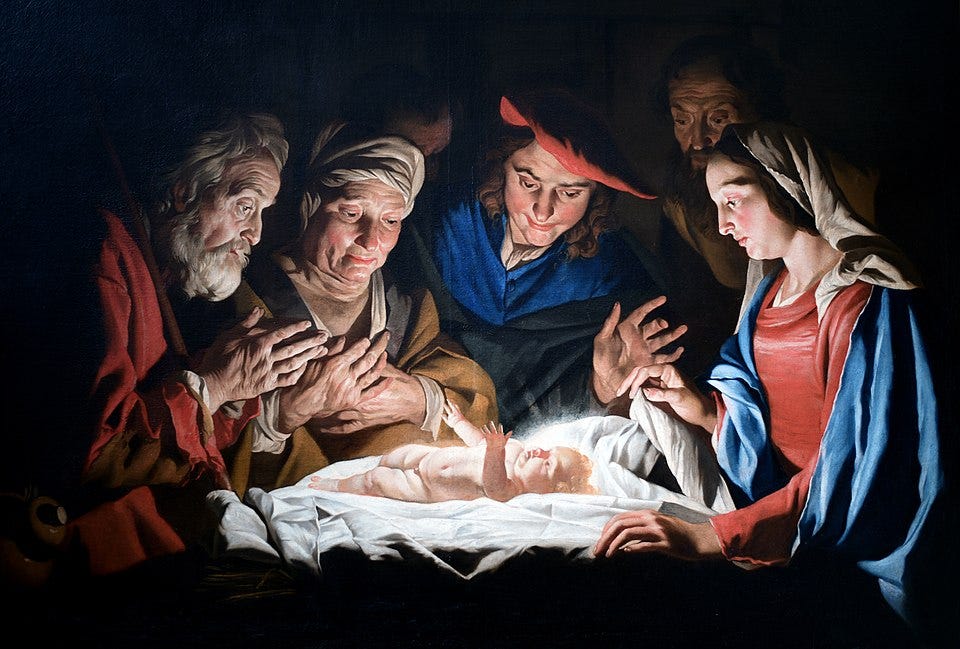

Okay, so we know that it’s sinful, displeasing to God, to celebrate Christmas as a religious holiday, but we saw last time that by the turn of the twentieth century, most Christians who had traditionally opposed Christmas had come around to the by-now traditional trappings of the day: feasting, gift-giving, time with family, and even Christmas trees and Santa Claus. I say most Christians had come around to this notion, not all. In the Churches of Christ, discomfort with Christmas—or even outright rejection—continued to the mid-point of the twentieth century, or even later. But when I was growing up in the 1980s and 1990s, I was completely unaware that some people thought that Christmas should not be celebrated at all, not even as a family holiday. That view was—and is—still around, but it’s pretty fringe.
But where do some people get off actually talking about the birth of Jesus on Christmas? How could they do such an ungodly thing?
Come to think of it, how do we know that observing Christmas as a religious holiday is sinful or ungodly? Last time we encountered the argument that we’ve got to avoid anything that makes us look like one of the denominations, and celebrating Christmas is, apparently, what the denominations do. Then again, last time we also learned that it was Protestant denominations like the Presbyterians who spearheaded the Christian opposition to Christmas, so it might be that refusing to celebrate Christmas is an imitation of the denominations. Hmm.
Let’s go back to the 1976 essay by John Waddey published in the Firm Foundation (“Christians and Christmas,” December 14, 1976, p. 792).
But no New Testament writing instructs us to observe a holy day for Christ’s birth. To so observe the day is to go beyond what is written. According to Christ such religious practices are vain worship for they are the precepts of men (Matt. 15:9). God gave his church only one special day, the first day of the week.
Wait a second; is that the reasoning? Let’s go over that again: “no New Testament writing instructs us to observe a holy day for Christ’s birth.” Um, okaaay. What in the world does that matter? Well, Waddey thinks that to observe this holy day in the absence of New Testament instruction would entail going beyond what is written, an allusion to 1 Corinthians 4:6. And he thinks Christ characterized such a departure from the written word as vain worship, citing Matthew 15:9.
That’s the same argument you’ll find in other authors. The early Protestants often opposed Christmas because it couldn’t be found in the Bible. Let me quote again an essay from The Oxford Handbook of Christmas (2020): “Those opposed to Christmas [in the sixteenth and seventeenth centuries] objected to any religious observance that was not explicitly commanded in the Bible (the so-called regulative principle) and which was seen as a vestige of popery” (p. 168).
And just to be clear about the argument, let me quote one of the most authoritative voices in Churches of Christ in the second half of the twentieth century. In the first volume of his Questions and Answers, Guy N. Woods had this to say about Christmas.
The observance of Christmas, as a religious holiday, did not originate in the apostolic age, and is thus without divine sanction. As a matter of fact, it is not possible to determine in what month, or on what day the Saviour…
and I pause just to note that the word “Saviour” is spelled in the British fashion, with a ‘u.’ I just think that’s weird. Anyway, back to the quotation:
…or on what day the Saviour was born and inasmuch as there is neither precept nor example for its observance, faithful Christians do not keep it as a religious festival. (p. 203)
Okay, “neither precept nor example for its observance.” That sounds similar to what Waddey had said.
Honestly, I can’t make any sense out of this. To go over it again, the idea is that it would be vain worship to observe a holy day in honor of Christ’s birth because such a holy day is not mentioned in the New Testament. I think part of my difficulty is this term “holy day.” That’s Waddey’s term; Woods used the term “religious festival,” and I assume that in this context “holy day” and “religious festival” are basically synonymous; whatever Waddey meant, Woods meant the same thing with his term. I’m not sure what these terms are supposed to mean, or what opponents of holy days think that they are opposing. Isn’t “holy day” and “holiday,” like, the same thing? It’s just a day set aside to observe a particular thing, right?
I mean, everyone would agree that it’s okay for Christians to observe Mothers Day, wouldn’t they? Have you ever heard of a church preaching against Mothers Day? I don’t remember Mothers Day being mentioned in the New Testament, but it doesn’t seem like Christians have usually thought about a special day for mothers as going beyond what is written, as vain worship. In fact, for my entire life, every single time the second Sunday of May rolls around, the sermon has revolved around mothers, and the mothers in the audience are specially singled out for greetings and warm wishes, and maybe even given a flower or some other present. Oftentimes the children’s Bible class that day focuses on mothers, and the children make a craft designed for their mothers. In a similar way, the churches I have been a part of have observed Fathers Day, and Veterans Day, and Thanksgiving Day, and the Fourth of July, and other special days. Is this going beyond what is written? Is this vain worship?
These special days are certainly not mentioned in the New Testament. But the excuse for observing Mothers Day that I have heard and that I have made is that Romans 13:7 tells us to honor those who deserve honor, and mothers—most mothers—deserve honor. It is not going beyond what is written; it is doing what is written. Now, I’ve never heard anyone say that Mothers Day is being observed as a holy day for mothers, or as a religious festival, but I have heard people talk about the holiday called Mothers Day. I’m not sure what the term “holy day” is supposed to communicate, and I’m not sure that people that oppose holy days do either.
Let’s go back to the reasoning for opposing the religious observance of Christmas. Nope, actually, before we do that, let’s think about that phrase: “religious observance.” Do churches typically oppose or embrace the religious observance of Mothers Day? I don’t know how you could get any more religious than centering your worship service around the reason for the season in the second week of May. Yes, of course, most American churches observe Mothers Day religiously. Again, it’s the same for Fathers Day and Thanksgiving Day and even the Fourth of July.
Now, let’s go back to the reasoning for opposing the religious observance of Christmas. As Waddey put it, “No New Testament writing instructs us to observe a holy day for Christ’s birth.” I have suggested that “holy day” is a term without clear meaning, and is basically in this discussion a red herring, a distraction. Let’s omit it. “No New Testament writing instructs us to observe Christ’s birth.” Or, as Woods said, there is “neither precept nor example for its observance.” As I see it, that claim is the nub of the argument against the religious observance of Christmas. We will have to consider whether the claim is true. Does the New Testament instruct us to observe Christ’s birth?
What Is There to Celebrate?
Does God want us to celebrate the birth of Jesus? Celebrate it in our churches and in our homes? Does God want us to religiously observe the birth of Jesus? Does Woods correctly evaluate the New Testament when he says that “there is neither precept nor example” for the observance, the religious observance, of the birth of Jesus? Or are there examples in the New Testament? Does the New Testament instruct Christians to celebrate Jesus’s birth?
Yes!
Yes!
Yes!
It is the most significant event in the history of the universe, and Christians should celebrate it. Religiously. As a holy day, whatever that means. The New Testament instructs Christians to celebrate the birth of Jesus.
Let’s probe why the birth of Jesus is so important, and here I want to go back to what I said last time, that “celebrating the birth of Jesus is not really the right way of saying it.” To my mind, the phrase “birth of Jesus” gives the wrong impression about what we’re doing. If a friend has a baby and we go to the hospital to celebrate with her the birth of her child, we will be holding the child and making goo-goo noises at the child—or, at least, my wife Jodi will do that. I myself will simply observe the infant from a safe distance. But I’m not a normal person. Most people will talk about how cute the baby is, how much fun infants are, the little noises they make, their silly little outfits. This has little correspondence to what we celebrate about Jesus at Christmas. It’s not so much the birth of a baby but the incarnation of God that we are celebrating.
“Incarnation” comes from a Latin term that means something like en-flesh-ment. (The root carn* in Latin means “flesh.”) Think about John 1. “And the Word became flesh” (John 1:14). This is the Word that John has already told us was with God in the beginning, and was itself—or himself—God. This word, this God, became flesh. The human being Jesus of Nazareth was God. There is much to discuss here, and much mystery. There were many early Christian debates, lasting centuries (or, actually, still ongoing), about how exactly to understand the identity of Jesus. One influential statement from the Council of Nicaea in the year 325 said that the Lord Jesus Christ is of one essence with the Father, very God of very God. While this language is not found in Scripture, the concept is, as we have just seen from the Gospel of John. (See more from Leonard Allen.)
Other stories depict divine beings taking on flesh—but not like this. Zeus sometimes became human—or some other creature of flesh—usually in order to get to know a young maiden better (see, e.g., Iliad 14.315–321; Odyssey 11.260–265). But Zeus did not stay in that form for long, certainly not for a lifetime. Zeus did not spend any length of time as a baby, getting his diaper changed, or as a toddler, or adolescent, or teenager. Zeus did not, as a human being, grow in wisdom and stature and in favor with God and men, as Jesus did.
In the Gospels we encounter the high God, creator of heaven and earth, through whom all things were made (John 1:3), who became a real human being, experiencing everything that human beings experience, from birth to death. That’s incarnation.
Early Christians celebrated the incarnation of God. I mean, come on, you don’t think Christians in the first century read the story of the Annunciation in Luke 1 and praised God that the Holy Spirit overshadowed a young woman to form within a virgin the holy Son of God? Don’t you think early Christians read about the praise of the angels before the shepherds in Luke 2 and joined in the celebration? “Neither precept nor example”? Give me a break.
Check out this passage:
Let this mind be in you, which was also in Christ Jesus: Who, being in the form of God, thought it not robbery to be equal with God: But made himself of no reputation, and took upon him the form of a servant, and was made in the likeness of men: And being found in fashion as a man, he humbled himself, and became obedient unto death, even the death of the cross. (Philippians 2:5–8)
Paul is talking about the incarnation—one who existed in the form of God, and emptied himself to take on the likeness of people. Many scholars have thought that this section of Philippians 2 represents an early Christian hymn. If that’s the case, then we have first-century Christians praising God in song for the incarnation, the birth of Jesus. Even if this passage wasn’t originally a song, it is certainly our Scripture now and we should sing it. We should praise God for the incarnation. We might also check out Colossians 1, where Paul says “in him all the fullness of God was pleased to dwell.”
I said earlier that the incarnation, the birth of Jesus, is the most significant event in the history of the universe. More significant than the crucifixion of Jesus? Yes! More significant than the resurrection of Jesus? Yes. Many other people died on Roman crosses, and their deaths had no bearing on me at all. Some other people rose from the dead, even in the Gospels, but their resurrections were not for my justification. What made the death and resurrection of Jesus different from those of other people? The incarnation, that’s what. His death was the death of the incarnate Son of God; his resurrection was the resurrection of the Lord of life who could not be held in death’s power. The crucifixion and resurrection are meaningless without the incarnation.
We should celebrate the birth of Jesus.
Mopping Up
Let me just deal with a few stray points here at the end.
First, I am fully confident that Guy N. Woods celebrated the birth of Jesus. Why? Because he was a Christian, and Christians celebrate Jesus, his birth, his life, his death, his resurrection, his ascension, and his present intercession on our behalf. It is inconceivable to me that Woods did not celebrate these aspects of Jesus’ life.
Second, is December 25 the actual birthday of Jesus? No, of course not. Or, maybe it was, I don’t know. Against this date you’ve got that argument about the shepherds that I mentioned last time, but I’m not sure how solid of an argument that is. At any rate, the date was not chosen because anyone had any actual knowledge of Jesus’ birthday, and it probably wasn’t chosen because of the Saturnalia festival. The most common theory as to why this date was chosen is the “Calculation Hypothesis,” and I’ll let you read about it on Wikipedia. At any rate, it’s just a day set aside for an observance, just like every other holiday.
Third, what about those pagan symbols? Well, symbols mean different things to different people. An image of the sun might mean “god” to the ancient inhabitants of Egypt but represent Jesus to ancient Christians.
But unto you that fear my name shall the Sun of righteousness arise with healing in his wings; and ye shall go forth, and grow up as calves of the stall. (Malachi 4:2)
The meaning of symbols is not established forever without the possibility of evolving. Just because some people may have worshiped a tree at one time does not mean that I should chop down every tree I see as if they’re all idols. I don’t have to regard them all as objects of pagan worship—especially when I don’t know anyone who worships trees or uses trees prominently in their worship. (This may have been a more potent argument in early medieval Germany.)
The Christmas Tree is a Christianized pagan symbol? Isn’t that a good thing? Doesn’t God want us to take pagan symbols and transform them into symbols of our faith? Isn’t that what has happened to the cross? (See Holland, pp. 1–12. “Whether in Korea or in Tierra del Fuego, in Alaska or in New Zealand, the cross on which Jesus had been tortured to death came to serve as the most globally recognised symbol of a god that there has ever been,” p. 12.)
Conclusion
It is a good thing for the people of God to join with the angelic chorus and celebrate the incarnation of our God, that is, the birth of Jesus. It is the most important event in the history of the universe. We should celebrate it at any time, even on a particular day set aside for that express purpose.